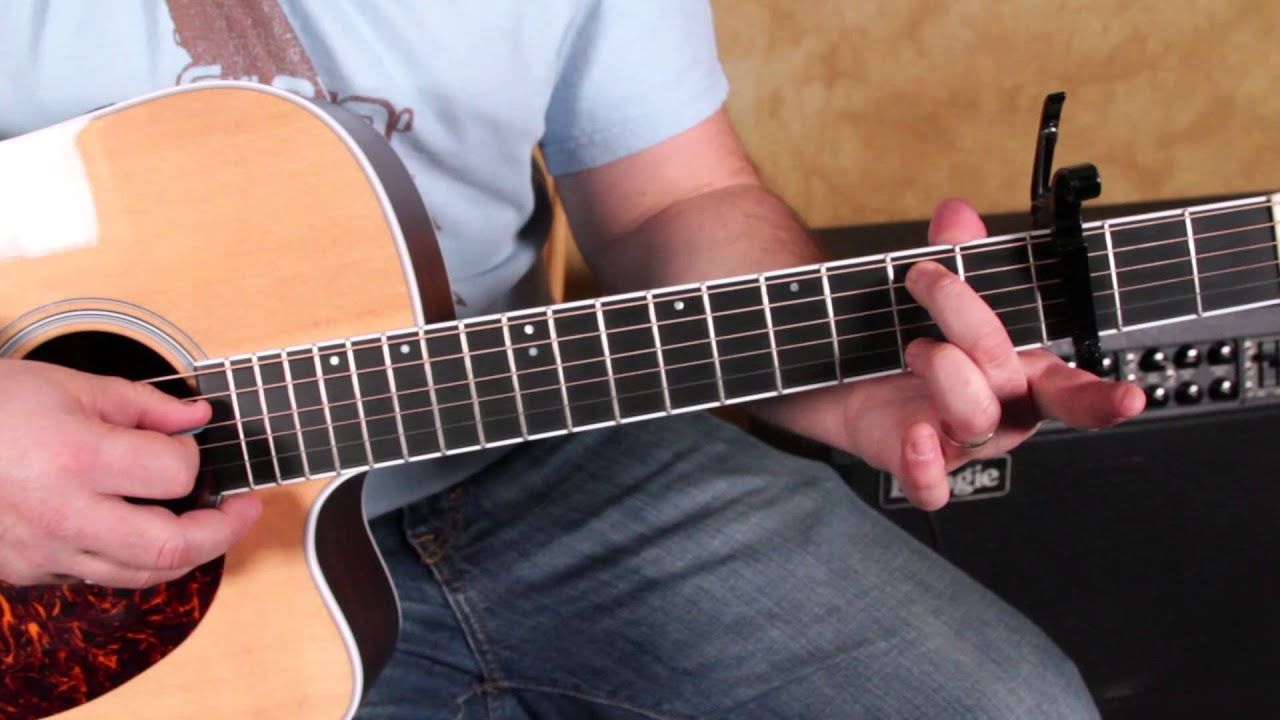
The song that tanked on release in 1968 spent 34 years waiting for its moment — then a Dutch producer remixed it for a Nike ad and it hit number one in 20 countries. That version is everywhere now, but the guitar part underneath it goes straight back to a Hollywood studio session in March of 1968, built on two dominant-seventh chords and a repeating blues lick that anyone can learn in an afternoon. In this lesson, Marty Schwartz breaks down the main A7–D7 groove, the blues lick connecting them, the electric guitar voicings from the original recording, and the bridge.
The Two Chords That Drive the Whole Song
The song runs on A7 and D7. That dominant-seventh sound is the whole flavor — it gives the track its raw, slightly swampy bite instead of the cleaner sound you’d get from straight major chords. Marty starts there.
For the A7, he holds a standard open A7 shape and adds his pinky on the third fret of the high E string. It’s a small addition, but it matches the color of the original session’s guitar parts more closely than the bare open chord does.
The D7 sits right next to it. Marty uses the standard open D7 shape — easy to grab and it locks in perfectly with the A7.
The groove between those two chords is the engine of the song. Get them under your fingers and alternate them with a confident strumming pattern, and you already have something that sounds right.
The Blues Lick Between the Chords
This is where the song gets interesting. There’s a repeating blues lick that connects the A7 and D7 sections, and Marty is clear: you don’t have to play it to get through the song. But the original recording has it, it sounds great, and it’s worth learning.
The lick starts on the A string. You hit fret 6, then 7 on the A string. Then you move to the D string: fret 5, up to 9, back down to 7, then 5, and then that blues note again at fret 6 on the A string.
That sequence — 6, 7 on the A string, then 5, 9, 7, 5 on the D string — is the little signature phrase that gives the original recording its personality. It sits right in the A blues scale and it’s comfortable to play once you slow it down and walk through each position.
Electric Guitar Voicings
Marty also covers how this plays on electric guitar, which is closer to what you hear on the recording. The Wrecking Crew session players — guitarists Neil Levang and Alvin Casey, plus Hal Blaine on drums — used fuller, barre-chord-style voicings to get that funkier, slightly grinding tone.
On electric, Marty moves to a full A7 barre chord voicing. Then for the C7-to-D7 move, he takes a C7 shape and slides it up a whole step. That sliding motion gives the chord change its punchy, rhythmic feel — it’s the difference between a clean acoustic strum and the grittier electric sound on the record.
On acoustic, the open chord versions work well and are easier to manage. On electric, the barre voicings and the sliding C7 shape bring you much closer to the original character of the track.
The Bridge
The bridge follows a slightly different pattern: A to C to D, and then it resolves to E. Marty points out that most of the moves are already in your hands from what you learned in the main groove — the bridge just extends the chord sequence one step further and gives the song its one moment of harmonic release.
It’s not a complicated shift. If you’ve worked through the A7 and D7 groove and the lick, the bridge comes together quickly. The E chord at the end is what gives the whole section its sense of landing somewhere.
Why This Song Is Worth Your Time
Billy Strange — the guitarist who co-wrote the song with Mac Davis — was a top Hollywood session player himself, and he served as music director for the film. That background shows in how guitar-forward the arrangement is. The whole thing was designed from the start around that dominant-seventh groove.
What makes it such a good learning song is how much it gives you with so little. Two chords, one repeating blues lick, a short bridge — and yet the combination sits squarely in blues-inflected rock rhythm playing. The dominant-seventh shapes, the blues lick positions, the sliding chord voicing on electric: each one of those is a technique you’ll reach for in dozens of other songs.
Work through the groove first, then add the lick when you’re comfortable. Marty’s breakdown gives you everything you need to get the whole thing sounding right.