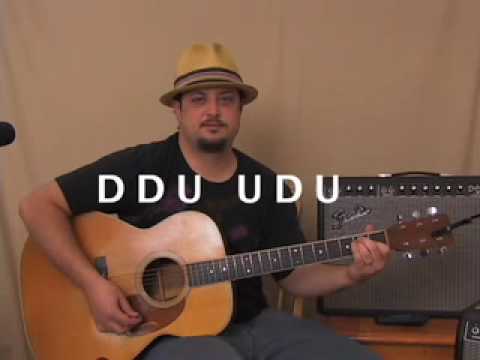
Smokey Robinson and his co-writer Al Cleveland wrote this song in 1967 after Cleveland accidentally said “I second that emotion” instead of “I second that motion” during a shopping trip in Detroit — and Robinson loved the slip so much they built a song around it on the spot. It hit #4 on the Billboard Hot 100 and #1 on the R&B chart, and the Grateful Dead later made it a live staple in the key of A. In this lesson, Marty Schwartz breaks down the chord shapes, the intro strum pattern, the verse, and the chorus — all of it built on one of the most useful chord progressions in guitar.
The Key and Why A Major
The original Smokey Robinson recording is in D major. Marty plays it in A major because that’s the key Jerry Garcia used when the Grateful Dead performed it. Same song, different key — and that’s actually one of the first lessons hiding inside this tune. You can move a I-IV-V song into any key to fit your voice or whoever’s singing. The shapes stay the same. Only the starting fret changes.
In A major, the three chords are A (the one chord), D (the four chord), and E (the five chord). That’s it. Three chords, one of the most recorded songs of the 1960s.
The Chord Shapes
Marty plays all three chords as barre chords, which keeps the shapes consistent up and down the neck. The A chord uses an E major barre shape at the fifth fret. The D chord uses an A major barre shape, also at the fifth fret — root on the A string. The E chord moves that same A shape up two frets to the seventh fret.
If barre chords are new, Marty notes you can swap in open versions of A, D, and E — the song still works. But the barre shapes are worth learning here because they sit right next to each other on the neck, which makes the transitions clean and fast.
The Intro Pattern
The intro runs through E, D, and A four times. Marty counts it out clearly: E, E — D, D, D — A. Three hits on E, three on D, then land on A. The pattern repeats four times, then holds on A before the verse kicks in.
That held A chord is the hinge point. The verse grows right out of it, so keep the strum going and don’t rush the transition.
The Verse
The verse stays on A for a stretch, which gives it that settled, conversational feel that matches the lyrics. When it moves, it goes to D, then E, then back to A. After that first move, it visits D twice and returns to A, hits D again, comes back to A, and then a short hit on A signals the chorus is coming.
The key thing Marty points out: the verse doesn’t rush through chords. It breathes on A. That’s true to the original recording, where the Funk Brothers — Motown’s house band — played with a lot of space. Eddie Willis and Robert White improvised their guitar parts from a chord chart, and that looseness is still in the DNA of the song.
The Chorus
The chorus opens on A, moves to E, then drops to D and stays there for a run of beats before heading back to A. That D chord sitting there is the emotional weight of the chorus — it’s where the title lyric lands. Marty plays through the chorus twice and shows how the final repeat stretches the chords a little wider: E gets three hits, D gets four, and then A holds to close it out before the next verse.
The Scale for Soloing
Once the rhythm is solid, Marty points to the A major pentatonic scale as the right tool for playing over this song. He mentions one useful trick: the A major pentatonic shares all its notes with F# minor pentatonic. If you already know F# minor pentatonic, you know A major pentatonic — the root is just in a different place.
The scale fits naturally over all three chords in this song. It’s a good one to have memorized, and “I Second That Emotion” is a comfortable place to start hearing how it works against a moving chord progression.
Why This Song Is Worth Learning
Marty calls this an “amazing example of the 1-4-5 of a major key,” and he’s right — but what makes it a good learning song is that the I-IV-V isn’t just a theory fact here. You can hear it working. A feels like home. D feels like it’s leaning away. E creates tension that wants to resolve. Play through the chorus a few times and that movement starts to make sense in a way that no amount of reading about chord theory can match.
It’s also a song with real history behind it. The Funk Brothers brought the groove, Smokey brought the melody, and a malapropism in a department store became a #1 R&B hit. That’s a good story to know when you’re playing it.
Stick with it. The chord shapes come quickly, and once the transitions feel automatic, the whole song falls into place fast.