“You Can Call Me Al” is one of those songs where the guitar part sounds deceptively simple — but there’s a whole groove underneath it that most players miss. What makes it even more interesting: the song’s central guitar riff wasn’t written by Paul Simon at all. It came from South African guitarist Ray Phiri during a jam session in Johannesburg, and the feel of that mbaqanga rhythm is exactly what gives the song its pull. In this lesson, Marty Schwartz breaks down the full song — the easy chord version, the verse changes, and the real African-style double-stop riff — so you can cover it on your own or get close to what’s happening on the original recording.
Setup: Capo on the 5th Fret
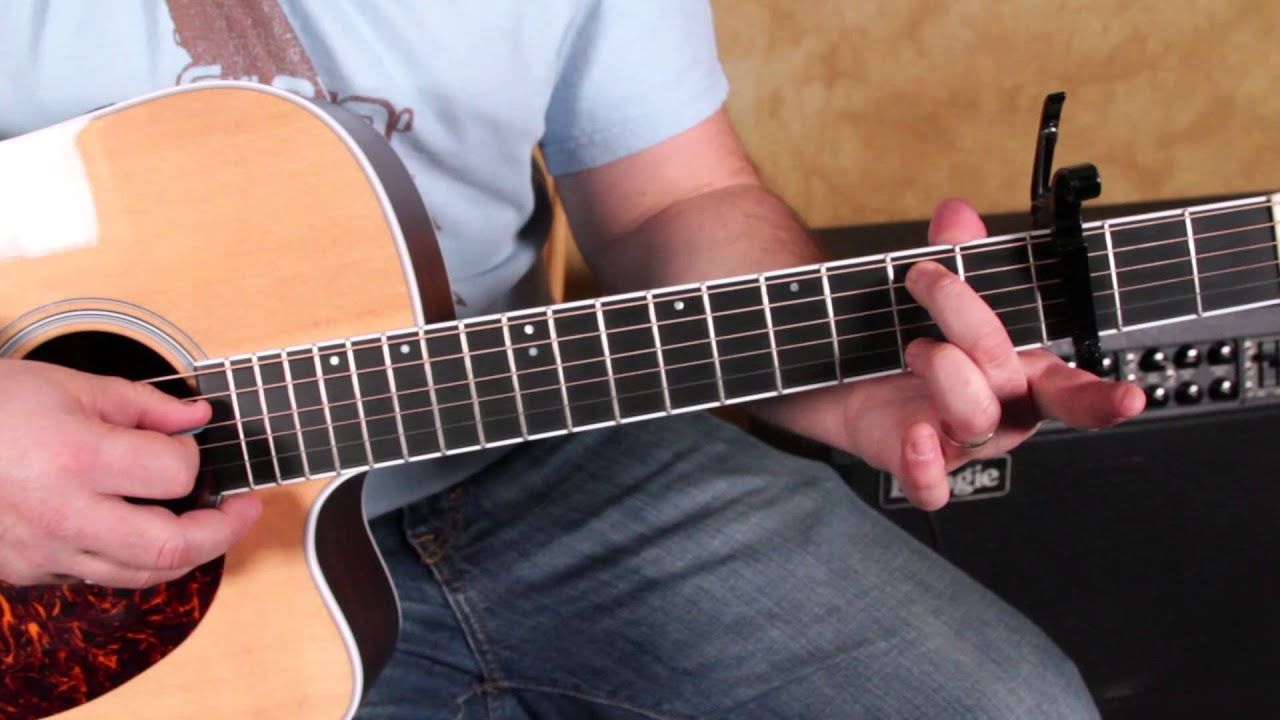
The first thing Marty does is put a capo on the 5th fret. This works on acoustic or electric. With the capo in place, the open chord shapes you already know will produce the right sounds for the song. It brings the key up and gives the guitar that bright, tight tone you hear on the record.
Everything Marty teaches in the chord section is played relative to the capo — so when he says “C,” he means a C shape with the capo acting as the nut.
The Chorus Chords
The chorus progression is four chords: C – G – G – F, then back to C.
Here’s how Marty fingers them with the capo on 5:
- C major — use your middle finger on the 3rd fret of the A string, ring finger on the 3rd fret of the D string, and pinky on the 3rd fret of the B string. Index finger can sit lightly on the 2nd fret of the D or float. Open G, B, and high e are included.
- G major — 3rd fret low E, 2nd fret A string, open D, open G, open B, 3rd fret high e. Standard open G shape.
- F major — barre the 1st fret across all strings, 2nd fret G string with your ring finger, 3rd fret A string with your pinky, 3rd fret D string with your ring finger. Standard open F barre shape.
The sequence Marty plays through is: C, G, G, F, then C, G, G, C, G, G, F, C, G, G, D. That D at the end is a brief pull into the next section.
The Verse Chords
The verse is a slightly different feel. Marty describes it as more subdued — not the big strum of the chorus. The changes are C – C – F – G.
That’s it. The song is not complicated harmonically. What makes it interesting is how you play those chords — the attack, the rhythm, the feel. That’s where the work is.
The African-Style Riff (Double Stops and Triads)
This is the part of the lesson that most people are here for. Once Marty has the basic chord version covered, he takes off the capo and teaches the real guitar part — the one you hear on the original track, rooted in South African mbaqanga style.
Marty suggests adding a light chorus pedal effect if you want that extra shimmer, but he teaches it clean. The riff is built entirely on the top two or three strings, using double stops and small triad shapes.
Here’s what the shapes look like, without the capo:
- F major triad (top strings) — 2nd fret G string, 1st fret B string, 1st fret high E string. This is your anchor shape. You want the B and high E ringing clearly.
- Third fret G and high E — 3rd fret on both the G string and the high E string. Ring just those two strings.
- Fifth fret G and high E — same idea, up a whole step. Just the G string and high E at the 5th fret.
The riff moves like this: start on the 5th fret double stop (G and high E), come down to 3rd fret, then land on that F triad shape at the 1st fret. From there, you hit the open G and high E with the 1st fret B string added in, go back to the F triad once, then land on just the 1st fret B string while getting the G and high E underneath it.
The pattern alternates. Marty describes it as every other — the F triad, then the open G and high E with the 1st fret B, then back to F. Those two shapes trade off in a rhythmic push that creates the groove.
Without a capo, the full chord names behind this riff are F – C – C – Bb. Marty also mentions that Bb can be played as an A-shaped barre chord sitting on the 1st fret — so your standard A-shape moved down one fret.
Why the Riff Feels the Way It Does
Marty makes a point of calling this an “African style” rhythm part, and that’s not just description — it’s instruction. The feel of this groove is slightly laid-back and syncopated. It doesn’t lock in mechanically. If you play it too stiff, it loses its character immediately.
The key is to let the fingers play the shapes loosely and let the rhythm breathe a little. The riff is not about speed. It’s about feel. Think less about hitting the notes perfectly and more about getting the rhythmic push-pull right. That’s what Ray Phiri brought to the original, and it’s what Marty is pointing at when he keeps calling it “African style.” The notes are easy. The feel takes repetition.
Putting It Together
Once you’ve got both parts — the simple capo-5 chord version and the open-position riff — you have two real options for covering this song. The chord version works great for a solo acoustic cover where you’re singing along. The double-stop riff version is what to reach for when you want to sound like the record, or when you’re playing with other musicians and need to hold down that rhythmic part.
Either way, you’ll have a song that genuinely surprises people when it comes out of a guitar. “You Can Call Me Al” is one of those tunes that sounds harder than it is once you know the shapes — and once you get that riff moving with the right feel, there’s almost nobody in the room who won’t stop and listen.