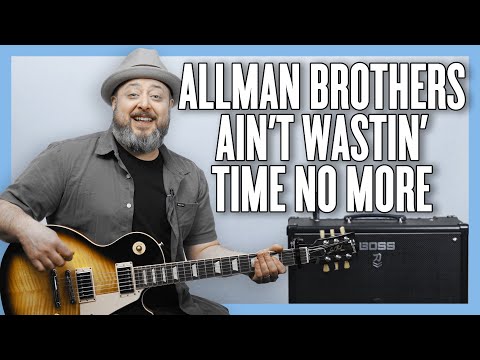
Gregg Allman wrote this song after losing his brother Duane to a motorcycle accident in October 1971 — and it became the opening track on Eat a Peach, the first record the band made without him. That backstory isn’t just trivia. It’s in the feel of every chord change. In this lesson, Marty Schwartz breaks down the capo and tuning setup, the core chord progression, and the slide fills that Dickey Betts famously worked out on the flight to Miami just to record them.
Setup: Capo, Tuning, and the Bb Mixolydian Thing
The recording is in Bb Mixolydian — and it sits slightly sharp of standard concert pitch on top of that. So right away, guitarists face a small challenge. Marty puts the capo on the first fret, which gets you into a familiar A-chord shape territory. But to really lock in with the record, you’ll need to nudge your tuning up a few cents above standard after you’ve clamped the capo on. Not a full half step — just a small push upward.
The reason the setup matters is the song’s signature riff is actually a piano part. Gregg wrote it on keys, not guitar. That means the open, rolling feel guitarists are trying to capture has to come from deliberate choices about which strings to emphasize. Marty keeps the focus on the D, G, and B strings to get the tone as close to that piano voicing as possible.
The Main Riff: One-Finger A and the Open Strings
The riff starts with a hammer-on at the second fret of the low E string into the open A string — and then settles into a one-finger A chord shape. That’s just one finger barring across the second fret of the D, G, and B strings. You leave the high E mostly alone.
If you play a full standard A major, it works — but it sounds more like a guitar chord and less like the piano source material. The one-finger version keeps it open and airy. For solo acoustic playing, Marty suggests dropping down to a G5 shape to get a low G in the bass, with the A string muted by the middle finger so the low note doesn’t cloud the voicing.
The Chord Progression
The main changes run through four chords. With the capo on fret 1, you’re thinking in A but sounding in Bb. Here’s what Marty covers:
- D major — the IV chord, bright and open
- A/C# — A major with C# in the bass (fourth fret of the A string), gives the progression a descending bass line feel
- B7 — the II chord, adds a little tension before the resolution
- E7 — the V chord, pulls back home
That A/C# is worth spending a moment on. You hold the A chord shape with your fingers and add the fourth fret of the low A string with your thumb, or rearrange your fretting hand so the bass note sits under the chord. Either way, the descending bass line — A down to C# — is what gives the verse its forward motion.
The Slide Fills
Here’s a piece of band history most people don’t know: Dickey Betts was not a regular slide player when Eat a Peach was recorded. He’d watched Duane closely, but slide wasn’t his primary tool. He reportedly worked out these fills on the flight down to Miami for the sessions. That makes them both a tribute and a crash course — and you can hear that they’re careful, intentional lines, not someone who’s been playing slide for years.
With the capo at fret 1, Marty identifies the slide position up around the 15th to 17th fret area (referencing open string positions, not capo-relative). The key move is bending the 17th fret of the G string on the high end, then resolving to the nearest dot — the 15th fret position. That’s the Allman Brothers pentatonic box right there, and those notes have that unmistakable Southern rock slide sound.
Marty is honest that the slide work in this song inspired him to practice slide more himself. That’s the right spirit. If you’re new to slide, don’t expect to land these fills perfectly in a first session. Play the chord progression solid first, then come back to the slide ideas once the changes feel easy.
The Bridge
The bridge leans on the IV chord — D major in capo terms. Marty keeps it simple there, and honestly the bridge is more about feel than complexity. Once you have the main progression under your fingers, the bridge falls naturally into place.
Playing It Solo vs. With a Band
This song rewards both settings but asks for different choices in each. With a full band, you can keep the guitar part lean and trust the other instruments to fill the space. Solo acoustic, you need more from the guitar — that’s where the lower G voicing in the bass helps, and where playing the D, G, and B strings cleanly matters most. The one-finger A shape is your best friend either way.
The Bb Mixolydian flavor — which just means a major key with a flat seventh — is what gives this song that open, unhurried Southern feel. It doesn’t sound tense or dramatic. It sounds like someone who’s made peace with something and is moving forward anyway. Which, given why Gregg wrote it, makes complete sense.
Take the progression slowly at first. Get the descending bass movement in the A/C# change sounding clear. Once those four chords feel comfortable, the rest of the song opens up. It’s one of those tunes that sounds harder than it is — and that’s always a good place to be.