“Self Esteem” came out in 1994 on Smash — the best-selling independent-label rock album of all time — and it turned The Offspring from a punk band with a following into a household name. Dexter Holland wrote it from a real relationship, which might be why those chorus chords hit so hard when they come back in. In this lesson, Marty Schwartz breaks down the full song: the power chord shapes, the verse build-up, the bridge progression, and the production trick that makes the chorus feel like a gut punch every single time.
Setup and Tuning
Standard tuning, no capo, no drop D. The whole song runs on two-finger power chords, so if you know that shape, you’re most of the way there already. The song sits around 107 BPM — not fast by punk standards, but the rhythmic feel matters a lot here. Marty’s tip on that: play along with the recording as much as you can. The upbeat hits are easy to miss on paper but click immediately when you hear them in context.
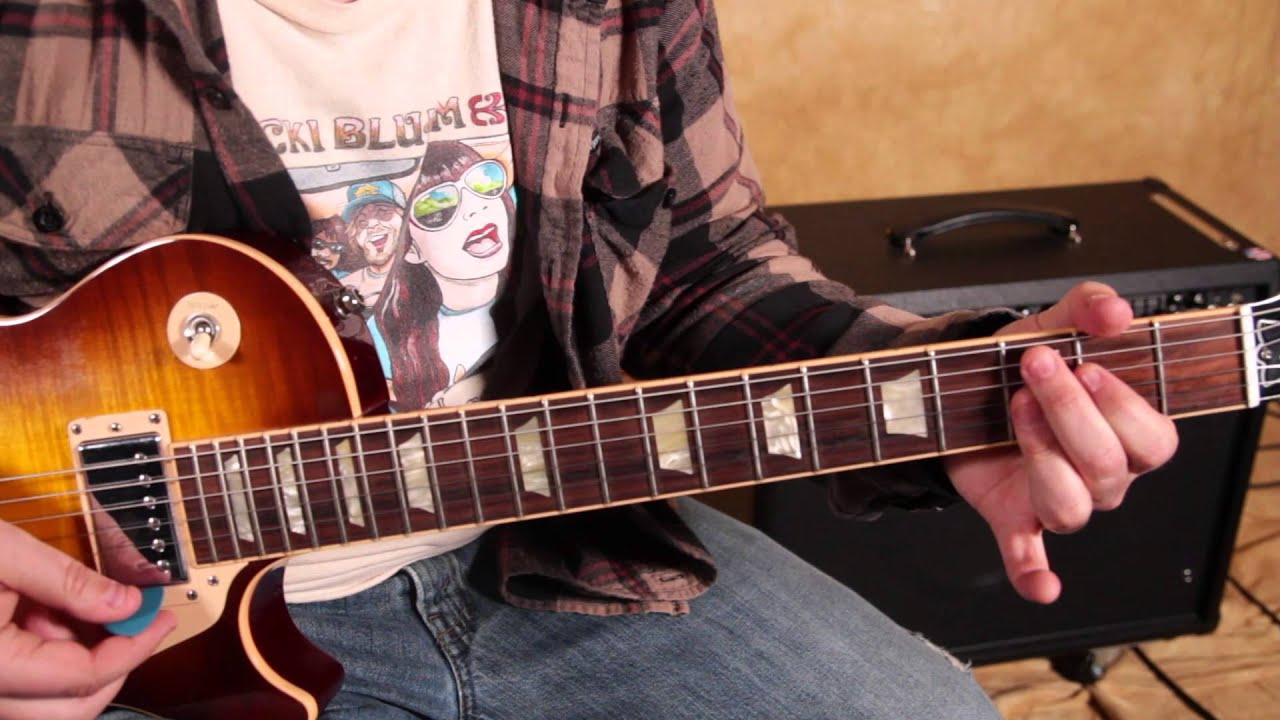
Marty uses the two-finger power chord throughout — index finger on the root, ring finger two frets up on the next string. The tip of the index finger lightly touches the strings above to keep them muted while you strum. That muting is what keeps everything clean and tight.
The Main Chord Progression (Intro and Chorus)
The song opens with four power chords that also drive the chorus. Here they are in order:
- A5 — 5th fret, low E string (root), 7th fret A string
- F5 — 8th fret A string (root), 10th fret D string
- C5 — 8th fret low E string (root), 10th fret A string
- G5 — 3rd fret low E string (root), 5th fret A string
Marty notes the similarity to the intro of “Smells Like Teen Spirit” — not as a criticism, just as a useful frame. The Offspring leaned into the Nirvana formula on this record, and knowing that helps you remember the feel. The second chord (F5) lands on the upbeat, which gives the whole progression its forward momentum.
The Verse Build-Up
The verse strips things way back. It’s bass, drums, and vocals — the guitar drops out almost entirely. That’s intentional. Holland and producer Thom Wilson borrowed the same trick Nirvana used: let the band breathe in the verse, so when the full power chords hit in the chorus, the contrast does the work. Noodles (Kevin Wasserman, the band’s guitarist) apparently found the slower, stripped-back arrangement unusual — they were a punk band, everything was supposed to be fast. But it works.
What Marty plays in the verse section is a palm-muted imitation of the bass line, using the same chord shapes. The F5 gets the palm mute treatment first — that’s the 1st fret low E, muted and chugged — then a quick move up to G5 at the 3rd fret. It’s spare and locked in. Marty points out that the G chord in this context can be played either at the 3rd fret low E or up at the 10th fret A string — same chord, just an octave higher.
The Bridge
The bridge introduces two new chord shapes. Here’s the progression Marty walks through:
- D5 — 5th fret A string (root), 7th fret D string
- Bb5 — 6th fret low E string (root), 8th fret A string
- F5 — 1st fret low E string
- A5 (A-string root) — 3rd fret A string
The rhythm pattern on the bridge is similar to the main progression, but the chord movement gives it a different feel — a little more unresolved, which fits the lyric. To exit the bridge, Marty uses D5 and Bb5 again, then steps up a whole step to C5 (8th fret low E), drops to 3rd fret, and ends with the chugging palm mute on the 1st fret F5. From there the song cycles back into the main progression.
The Outro and Final Slide
The song ends cleanly. After the final bridge, the progression lands on that A-string root A chord at the 3rd fret, then slides straight up to the 5th fret low E — which is the A5 that opened the song. So it’s 3rd fret A string, slide to 5th fret low E, and you’re done. It’s a satisfying resolution that Marty flags as a deliberate structural choice: the song ends on the same chord it started with.
Why It Works on Guitar
There’s a reason this song has appeared in beginner lesson libraries for thirty years. It’s not just that the shapes are simple — it’s that the arrangement teaches something real. The verse/chorus contrast is a production concept you can feel in your hands. When the palm muting gives way to open strummed power chords, that’s not an accident. It’s the same principle behind dozens of classic rock songs: restraint in the verse makes the payoff land harder.
Noodles recorded Smash on a Gibson Sonex through a Mesa/Boogie Mark IV. You don’t need either of those to make this sound right — any electric with moderate gain will do the job. The technique is what carries it.
Give it a few runs with the recording once you’ve got the shapes under your fingers. The rhythmic nuance Marty mentions — especially that upbeat F5 — is the part that takes a little time, but it clicks. And when it does, the whole song snaps into place.