This Baba O’Riley guitar lesson will teach you one of The Who’s most recognizable anthems. While that iconic synthesizer intro gets all the attention, the guitar work in this song is what really drives the energy. You’ll be working with power chords, precise timing, and some tricky rhythm changes that make this an excellent intermediate challenge. The song might seem straightforward at first, but Pete Townshend’s guitar parts have subtle details that separate the pros from the beginners.

The guitar tone is raw and punchy, with just enough distortion to cut through that famous synth loop. What makes this song particularly fun to play is how the guitar and synth complement each other. You’re not trying to compete with that repetitive electronic pattern, you’re adding the human element that makes people want to move.
The Story Behind the Song
Pete Townshend wrote “Baba O’Riley” as part of his ambitious Lifehouse project in 1971, though it ended up on Who’s Next instead. The title combines two of Townshend’s influences: Meher Baba, an Indian spiritual master, and Terry Riley, a minimalist composer known for repetitive musical patterns. That explains the hypnotic synth loop that opens the song.
Townshend recorded the synthesizer parts himself using a Lowrey organ with built-in rhythm presets. He fed the band members’ vital statistics into the machine to create personalized rhythm patterns, which sounds absolutely wild for 1971. The guitar parts were recorded with his famous Gibson SG through a Marshall stack, giving it that classic British rock sound that influenced countless players.
The song became a cultural phenomenon, appearing in everything from CSI to countless sports montages. It peaked at number 9 in the UK and has become one of The Who’s signature songs alongside “Won’t Get Fooled Again” and “Behind Blue Eyes.”
What You’ll Learn
- Power chord transitions between F, C, and Bb
- Palm muting technique for controlled distortion
- Syncopated rhythm patterns that lock with the synth
- Dynamic control between verse and chorus sections
- String damping to avoid unwanted noise
- Proper power chord fingering for quick changes
Chord Progression Breakdown
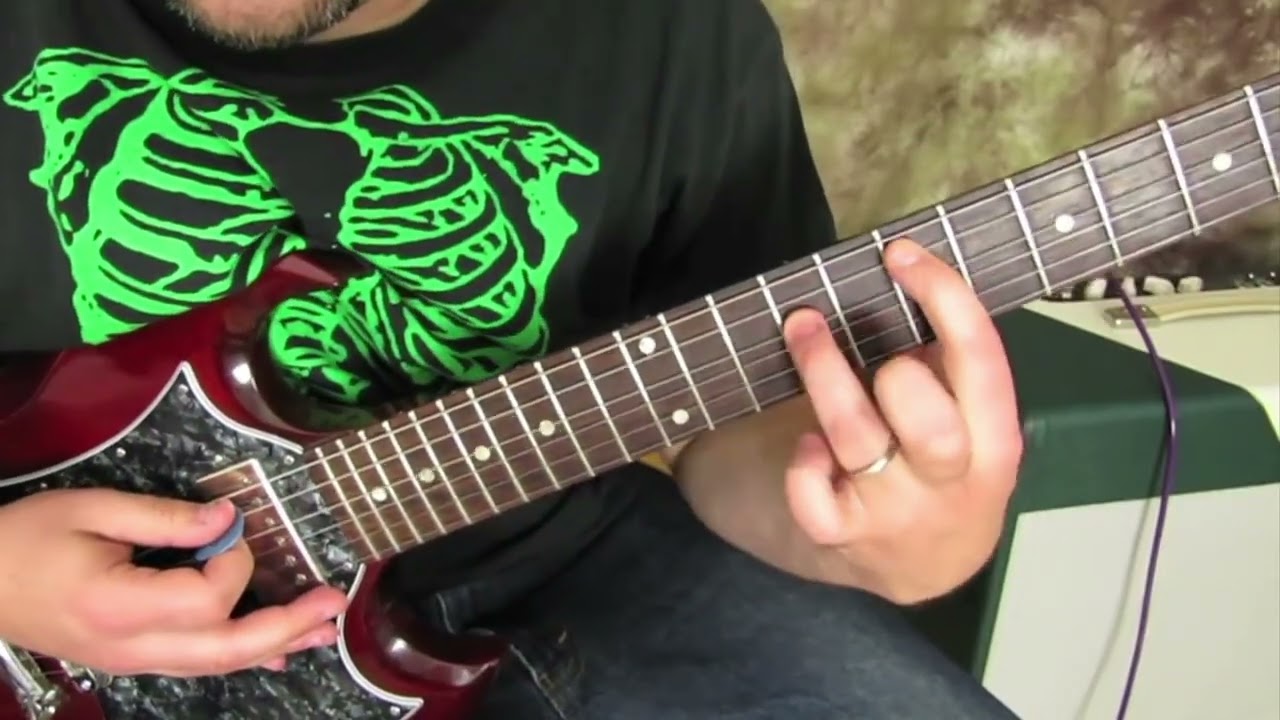
The main progression revolves around three power chords: F5, C5, and Bb5. These aren’t full barre chords, just the root and fifth played on the low strings. For the F5, place your first finger on the first fret of the low E string and your third finger on the third fret of the A string. The C5 moves up to the third fret low E and fifth fret A string. The Bb5 is just one fret down from the C5.
The tricky part isn’t the chord shapes themselves, it’s the timing. You’re not just strumming along with the beat. The guitar comes in with short, punchy hits that accent certain parts of the synth pattern. Think of it as adding punctuation marks to a sentence rather than writing the whole thing.
During the verse sections, you’ll mostly play single hits on the F5, letting each chord ring briefly before muting it. Your right hand does most of the work here, controlling exactly how long each chord sustains. Too much ring and it gets muddy, too little and it sounds choppy.
Verse Pattern
The verse uses primarily F5 with occasional moves to C5. Don’t overthink this section. Play the F5 on beats 1 and 3, with a quick C5 hit every few measures. The key is staying tight with that synth loop. If you have trouble hearing when to come in, count along with the electronic pattern until the guitar entrance becomes obvious.
Chorus Explosion
The chorus opens up with a more driving rhythm. You’ll cycle through F5, C5, and Bb5 with more frequent chord changes. This is where the song really comes alive, so don’t hold back on the energy. The power chords should sound full and aggressive, but still clear enough that each change is distinct.
Strumming Pattern & Rhythm
Forget traditional strumming patterns for this song. You’re playing individual hits rather than continuous strumming. Think of your right hand as a drumstick hitting specific accents. Each chord should be a deliberate strike, not a casual strum.
Start by playing along with just the synth loop before the full band comes in. This helps you feel where the guitar naturally wants to enter. Most players rush the timing on this song because they’re excited to get to the rock parts, but patience makes all the difference.
Your picking hand needs to be ready to mute immediately after each hit. This isn’t a song where you let chords ring out. Rest your palm lightly on the strings near the bridge, just enough to control the sustain without killing the tone completely. You want controlled power, not muddy noise.
Practice Method
Practice the rhythm without worrying about chord changes first. Just play F5 along with the track, focusing entirely on getting the timing right. Once that feels solid, add the chord changes one at a time. Don’t try to learn everything at once.
Use a metronome if you’re practicing without the track. The song sits around 120 BPM, but the synth pattern makes it feel faster. Count in quarter notes and place your hits where they feel natural against that steady pulse.
Tips for Playing This Song
Start with clean tone: Learn the parts with a clean or slightly overdriven sound first. Distortion hides timing problems and sloppy technique. Once you can play it cleanly, add the distortion for that authentic rock sound.
Watch your muting: Unwanted string noise kills this song faster than anything else. Keep your fretting hand fingers curved so they don’t accidentally touch other strings. Your picking hand should also help mute strings you’re not currently playing.
Don’t fight the synth: Some players try to overpower that electronic loop with loud, constant guitar. Work with it instead. The synth provides the foundation, your guitar adds the excitement on top. Think rhythm section, not lead guitar.
Record yourself: This song sounds different when you’re playing it versus when you’re listening to it. Record yourself playing along with the track and listen back. You’ll hear timing issues and balance problems that you miss while playing.
The most common mistake is rushing through the quiet verse sections to get to the big chorus parts. Those subtle verse hits are just as important as the powerful chorus chords. Take time to make every note count, regardless of volume level.
“Baba O’Riley” teaches you that great rock guitar isn’t always about complexity or speed. Sometimes it’s about playing the right thing at exactly the right moment. Work through this song slowly, focus on the details, and you’ll have one of rock’s greatest anthems in your repertoire. Keep practicing with the video lesson until those power chords feel completely natural.