Tom Hamilton had been sitting on the bass riff for Sweet Emotion for years before it almost missed the album entirely — the band built the whole song around it on the final recording day in 1974, treating it as a throwaway jam session. It became Aerosmith’s first Top 40 hit. In this lesson, Marty Schwartz breaks down the iconic bass riff, the sus chord shape, the driving power chord groove, and the end-section jam so you can play the full song from start to finish.
Gear and Tone Setup
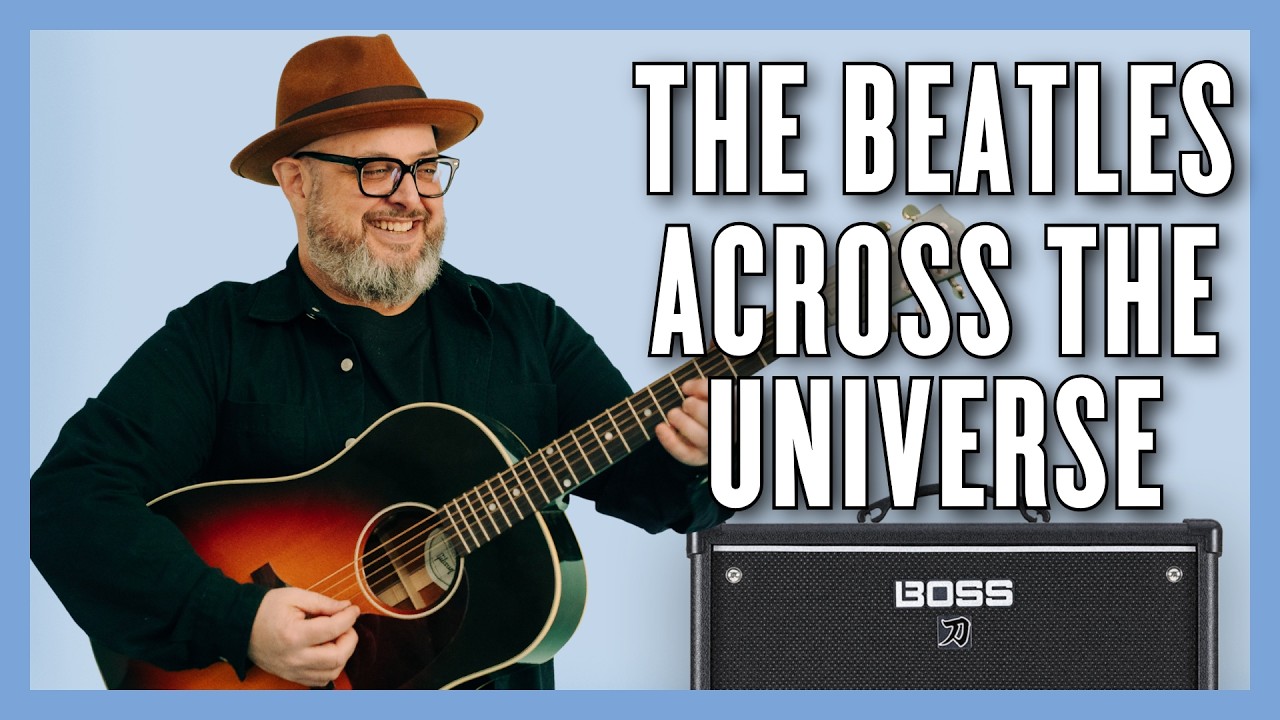
Marty records this lesson on the Boss Katana and mentions there’s a free downloadable patch that matches the tone he uses throughout. You don’t need that exact setup — any amp with a bit of crunch and some low-mid weight will get you there. This is a classic rock tone, not high-gain. Think controlled dirt, not shred.
Standard tuning. Key of A. No capo.
The Bass Riff (The Heart of the Song)
This is what makes the song. Marty points out that you can play this riff note-for-note on guitar or bass — same fingering, same strings. It lives on the open A string and climbs up the A string at the 10th and 12th frets.
Here’s the sequence:
- Hit the A string at the 10th fret once
- Move to the 12th fret
- Let the open A ring
- Hit the 5th fret, then two quick open A’s
- Land on the 4th fret
The riff has a hypnotic, lopsided feel — and that’s intentional. When drummer Joey Kramer first played along to Hamilton’s riff in the studio, he came in on the wrong side of the beat. Tyler and producer Jack Douglas heard it and said “that’s genius.” They kept it. That backward placement is exactly why the bass riff sounds so weighty and strange. You’re not playing it wrong if it feels off — it’s supposed to.
The Sus Chord Shape (Verse Rhythm)
Marty moves into what functions as the main rhythm part of the verse. It starts with a basic A power chord — index finger covering the 2nd fret of both the D and G strings, with the thumb resting over the low E to keep it quiet. Then it gets interesting.
From that A shape, he adds a sus sound by fretting the 3rd fret of the B string with the pinky, ring, or middle finger — whichever is most comfortable. Then there’s a pull-off on the 3rd fret of the A string with the middle finger, and a hit on the 3rd fret of the high E before landing back on the A chord. It gives the whole riff a bouncy, restless quality.
The Main Riff (The One You’ve Been Waiting For)
This is the signature guitar riff — the one that kicks in over the verse and carries the whole song forward. Marty breaks it down slowly.
- Start on the 5th fret of the A string, pull off to the 3rd fret
- Hit the 5th fret of the low E string
- Open E, then slide up to the 2nd fret
The rhythm is the tricky part. Marty describes it as “da da da da” — the 3rd fret gets two quick hits, and the 4th fret gets a slightly longer “duda” feel. There are open E notes that act almost like passing tones leading into each phrase. They’re quiet, almost throwaway, but they make the riff groove the way it does.
The first time through in the song, this riff is short. Then it repeats and extends. Then it extends again. Marty recommends playing it with power chords — especially if you’re the only guitarist in the room. Since Aerosmith is a two-guitar band, the original recording layers the single-note riff against rhythm power chords. Playing chords on the 3rd, 4th, and 5th frets fills the space well.
The Outro Jam in E
Later in the song, the riff transforms. The same basic idea moves to the low E string — open E, then up to the 10th and 12th frets, similar to how the A string riff opened the song. Marty adds hammer-ons and a bit of bluesy looseness to it. The original recording has Joe Perry doing his thing here with a talk box — that wobbly, vocal-like effect you hear fading out at the end.
For playing purposes, Marty suggests just jamming in an E blues feel over this section. You don’t need the talk box. A minor pentatonic or E blues scale over those open E-string hits will sound exactly right and give you room to stretch.
Putting It All Together
The song has a clear structure once all the pieces are in place:
- The bass riff intro (open A, 10th, 12th frets)
- The sus chord verse rhythm (A power chord plus B string sus)
- The main guitar riff (A string pull-off, into E string run)
- The extended riff — same shape, played out longer
- The E-string jam outro — open E up to 10th and 12th, with bluesy fills
One of the things that makes this song so satisfying to learn is how much mileage you get out of a small set of shapes. The bass riff and the guitar riff share the same DNA — open strings, 10th and 12th fret, a bit of blues vocabulary. Once the bass riff clicks in your hands, the rest of the song starts to make sense pretty fast.
It took Hamilton years to find the right song for that riff. You can learn it in an afternoon.