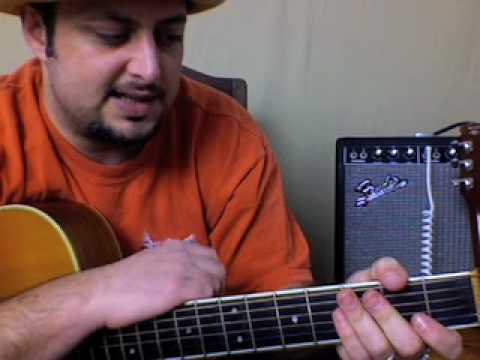
Stevie Nicks wrote “Rhiannon” on a piano using only two fingers, inspired by a character possessed by a witch’s spirit in a 1972 novel. Lindsey Buckingham then turned that sketch into one of the most recognizable guitar parts of the 1970s — a fingerpicked riff built around a thumb-over-the-neck bass technique that became his signature. In this lesson, Marty Schwartz breaks down the intro riff, the thumb-driven fingerpicking pattern, the main chord shapes, and the full song progression so you can play it in standard tuning with no capo.
Setup: Standard Tuning, No Capo
There’s nothing unusual to prepare here. The song sits in standard tuning (EADGBE), no capo, no alternate tuning. The key is A minor. What makes it feel tricky at first isn’t the notes — it’s the right-hand technique. Marty uses a fingerpicking approach where the thumb handles the bass strings while the index and middle fingers pinch the higher strings. Getting that coordination down is where most of the practice time goes.
The Core Chord Shapes: Am and F
Almost the entire song is built from fragments of two chord shapes: A minor and F major. Marty pulls small two-note pieces from each and moves between them on the high strings. Before you touch the riff, it’s worth getting these shapes under your fingers.
The riff borrows the first-fret B string and second-fret G string from A minor. That same fragment shows up inside the F chord shape too, which is why the two chords lock together so cleanly in the progression.
The Intro Riff: How It Works
Marty starts by isolating a two-note piece of the A minor chord: first fret on the B string, second fret on the G string. He pinches those with his index and middle finger. The thumb takes the open A string as a bass pedal running underneath.
The full pattern moves like this over A minor: pinch the G and B strings at the second and first fret, then move up a whole step (third and fourth fret), then shift the middle finger up a half step to the fifth fret of the G while the ring finger takes the fifth fret of the B. After that, it comes back down, then opens up to the open G and B strings before hopping to the second fret of the D and G strings — still part of that A minor shape.
The riff movement happens on the G and B strings.
The specific pattern in the recording has the open A string acting as a steady pedal. Marty points out that if the full picking pattern feels like too much at once, even just keeping that open A note ringing underneath everything already sounds like the song. The pedal tone is what sells it.
Adding the Thumb Bass
This is the Lindsey Buckingham move. The thumb wraps over the top of the neck and frets bass notes on the low strings while the fingers handle the high-string melody. On the intro, the thumb plants the open A string as a drone, but when the song shifts to the F chord section, the thumb moves to fret the bass note at the first fret of the low E string.
Marty demonstrates how, once the F chord comes in, he holds that thumb bass note and pinches the D and G strings at the third and second fret to start the F fragment. Then he opens up to the G and B strings and cycles back through the same two-note pieces he was using over A minor — because, as he points out, that little two-note shape lives inside both chords. The harmony changes; the hand position barely moves.
The Full Chord Progression
The song cycles through Am, F, and C. Marty recommends getting a C chord under your fingers so you can hear how it fits the tonality of the whole piece, even if the riff doesn’t outline it as clearly as it does the other two chords.
When C comes in, Marty moves to the second fret of the D string with the open G — then shifts up to the third fret with the second fret on the G. That same melodic idea repeats three times before landing back on F. The C section uses the same scale, same key, same principles as everything before it. There’s no jarring shift; it all flows from the same A minor world.
When the Band Kicks In
Marty notes that once the full band enters on the recording, the intricate thumb-bass line becomes less audible — other instruments are carrying the low end. At that point, playing the chords more directly with the melodic fragments on top still works perfectly. The pattern is most important in the quiet intro where it’s the only thing happening. Once the band fills in around it, a more straightforward approach to the chord changes reads just fine.
The end tag lands back on F. Marty suggests it’s possibly just the right-channel guitar in the original, so a clean F chord shape voiced simply gets you there without overcomplicating it.
Putting It Together
“Rhiannon” hit the Billboard Hot 100 at #11 in early 1976 and became the song that established Stevie Nicks as the center of the new Fleetwood Mac lineup. Mick Fleetwood once described her live performance of it as “like an exorcism.” There’s a reason it became that kind of song — it has a hypnotic quality that comes entirely from this guitar part, from that open A pedal tone and the way the same two-note fragment floats between chords without ever settling.
Marty’s approach makes it approachable: learn the two-note shapes first, get comfortable with the pinching motion, then add the thumb bass underneath when the hands start cooperating. Work the A minor section until the pattern feels automatic, then introduce the F. The C is the easiest of the three. Once those three sections are connected, the full song is there. It’s one of those pieces that rewards patient repetition — the more it gets into the fingers, the more it starts to feel the way it sounds on the record.