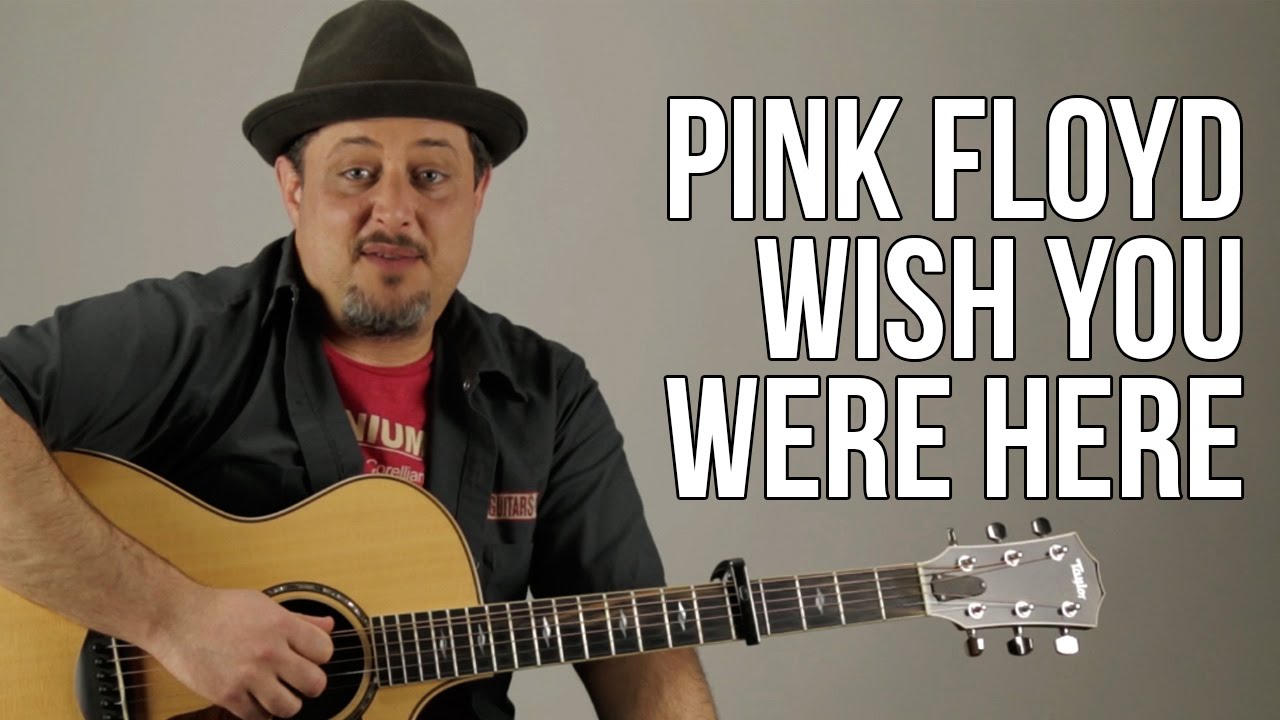
“By the Way” hit in 2002, and John Frusciante wrote so much of it — the melodies, the bass lines, the backing vocal stacks — that the record ended up sounding more like a Beatles album than anything RHCP had done before. The guitar work is dense and layered, but the core shapes are completely learnable. In this lesson, Marty Schwartz breaks down the intro power chord variations, the D minor pre-chorus riff, the full F–C–Dm–Bb chorus, and Frusciante’s Hendrix-style thumb voicings that give those chords their piano-like weight.
Setup and Key
The song is in F major. Standard tuning, no capo. The main chord loop that runs through the verse and chorus is F, C, D minor, and B-flat — a I–V–vi–IV movement that sits in a very comfortable range on the guitar. Frusciante tracked most of the album on a vintage 1962 Fender Stratocaster through a pair of Marshall heads running in stereo, but any guitar with decent single-coils will get you close.
The Intro — Four Variations on the Same Progression
Marty takes care to show that the intro isn’t just one repeated riff. It cycles through four slightly different versions of the same basic idea, and they build in density each time around.
Version 1 — before the vocals come in — starts with an F power chord. Marty frets it at the 8th fret on the A string and 10th fret on the D string, but he uses his pinky on the D string rather than the ring finger. That matters, because the index finger needs to be free to drop down to the 7th fret for the next move. It resolves to a simple two-string A power chord higher up the neck.
Version 2 — when the vocals enter — adds an octave note on top of the F power chord (8th, 10th, 10th on A, D, G strings). Marty describes it as sounding “almost like a doorbell.” This version resolves to the same A power chord but now also with that extra octave G string note stacked on.
Version 3 introduces a C over E chord in place of the straight C. The pinky moves to the 10th fret D string, the ring finger hops to the 9th fret G string, and the index drops to the 7th fret. Then instead of the A power chord with its root, Marty drops the root entirely — index finger on 7th fret A and D strings, ring finger on 9th fret G, and that covers what Flea is handling in the bass anyway.
Version 4 brings back the F power chord with the octave, then the C power chord, then the A chord with the octave — and the last part adds the 9th fret G string and 10th fret B string with ring and pinky. It’s a big, rootless A voicing. Flea’s bass covers the bottom, so it rings full even without the A root string.
The Pre-Chorus Riff — Muted Funk and D Minor
Between the intro and the chorus there’s a percussive, muted “chicka chicka” section. Marty notes it probably has a wah pedal on it, maybe some kind of filter effect. That lines up with what Frusciante was actually using — a Line 6 FM4 Filter Modeler was a big part of his By the Way rig, alongside his Ibanez WH-10 wah.
The riff rocks around D minor, and Marty plays it in the E-root box position — root at the 10th fret of the E string. The key notes are the 12th fret D string (root octave) and 10th fret on G and B strings. The funk technique here is adding the pinky to the 13th fret B string, which gives you the octave of the root — a classic funk move. If you barre across those strings instead, it becomes a Dm7 chord shape.
The rhythm is percussive. Marty emphasizes that a lot of what you hear in this section is right-hand muting and release — the left hand is mostly holding the shape while the right hand does the rhythmic work.
The Chorus — F, C, Dm, Bb
The chorus uses the same chords that have been present in the intro all along, just spelled out cleanly now. The sequence goes F → C → Dm → Bb → C → F, with an Am also appearing. Marty plays the F at the root position with an Am shape — that’s the standard open-position F barre or the Am shape moved up to the first fret depending on your preference.
Marty also shows the Bb resolving up to a B-flat major in the Am–Bb movement — it’s a minor i to flat-II kind of shift that gives the progression a slightly darker color before it resolves back to F.
Frusciante’s Hendrix Thumb Voicings
Here’s where the chord sound gets interesting. Marty demonstrates how Frusciante plays these chorus chords “Hendrix-style” — wrapping the thumb over the top of the neck to fret the low E string root. So for the F chord, instead of barring across all six strings with the index finger, the thumb reaches over and grabs the root F on the first fret E string, freeing the other fingers to voice the chord more openly across the remaining strings.
Jimi Hendrix used this constantly, and it’s a defining technique of his chord-melody style. Frusciante absorbed it, and it’s all over the By the Way album. The result is that chords feel fuller and more piano-like — and live, it lets him cover the harmonic bass note even in a three-piece setup where Flea handles the bottom.
If your hand is on the smaller side, the thumb-over grip can be a stretch at first. Marty notes that both approaches — barre chord or thumb-over — function the same way harmonically. Start with the barre version and work toward the thumb voicing as your hand gets comfortable with the neck.
Putting It Together
The song teaches a few things at once. First, how small variations on a repeated progression can build tension across an intro — each of those four versions adds a layer. Second, how right-hand muting creates percussive rhythm in the pre-chorus section without needing any flashy technique. And third, how the Hendrix thumb voicing changes the physical feel and tonal weight of a standard barre chord.
Marty’s approach throughout is to show the function of each shape — why the pinky goes there, why the root gets dropped, why the octave gets added. That context makes the shapes stick. Run through the intro variations slowly, get the D minor riff muting clean, then work the chorus progression until the chord changes feel automatic. The rest follows from there.