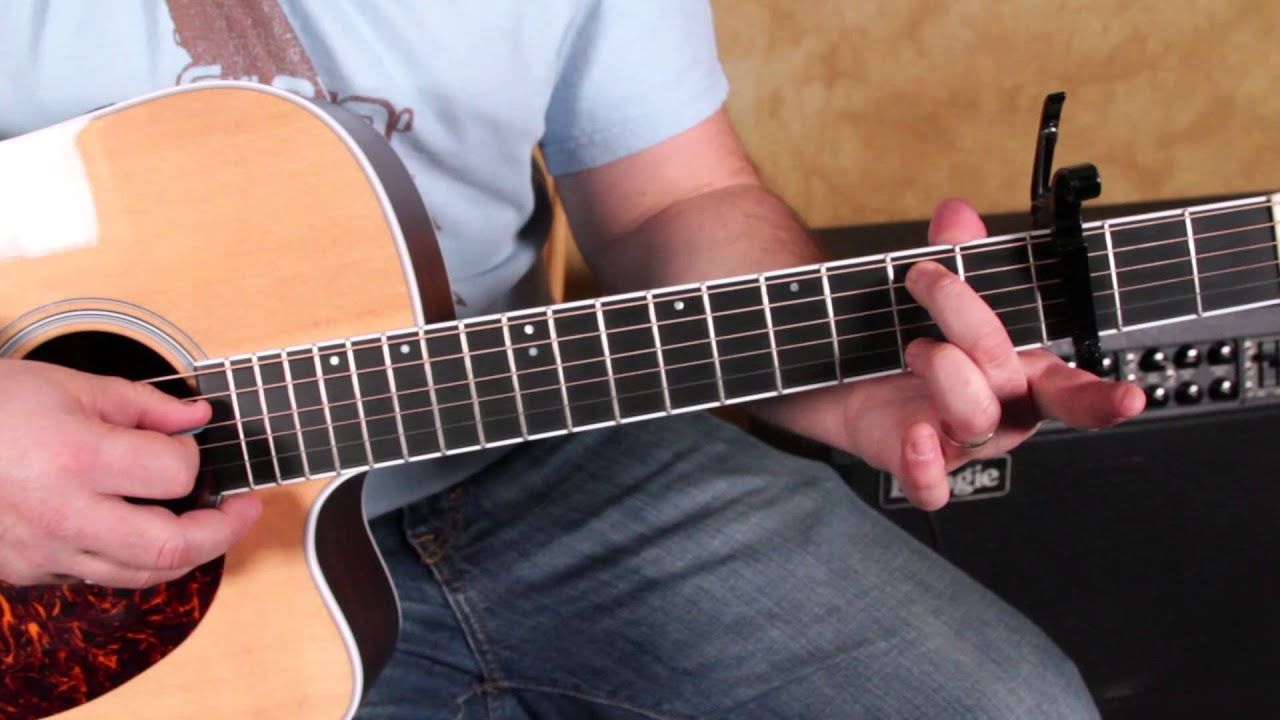
Neil Finn wrote “Don’t Dream It’s Over” at his brother’s piano in a single day — and still wasn’t sure it was special until a bassline suggestion from producer Mitchell Froom gave it the groove that made it a global hit. The record reached No. 2 on the US Billboard Hot 100 in 1987, and the chord movement behind it is one of the best teaching vehicles in pop: a I–vi–IV–V built from sliding barre shapes, with just enough sus color to keep it from sounding ordinary. In this lesson, Marty Schwartz breaks down every section of the song — the verse, chorus, and bridge — and shows how a handful of moveable shapes cover the whole thing.
Setup: Key, Capo, and Starting Position
The song is in E flat major. No capo is used in this lesson — Marty plays all the shapes as barre chords. The root chord, E flat, sits with its bass note on the sixth fret of the A string. That’s the anchor everything else moves from.
Marty’s first instruction is worth noting: skip the low E string entirely on this chord. The A string on the sixth fret is the root, and letting the low E ring muddies the sound. Start the strum from the A string.
The Root Chord: E Flat Major
Marty builds the E flat from a partial barre. The index finger bars across the sixth fret, the ring finger goes to the eighth fret of the D string, and the pinky lands on the eighth fret of the G string. Then he adds a variation — pinky moves up to the ninth fret of the B string — which gives the chord a sus4 color on the way back around. That in-and-out motion between the basic shape and the sus4 is the rhythmic kernel of the whole intro and verse.
The strum direction matters here: Marty strikes upward toward the treble strings to bring out the high notes on the B and e strings.
The Verse Chords
The verse runs through four chords: E flat, C minor, A flat, and G major. Every one of them is a barre chord shape moved around the neck — which is exactly what makes this song approachable for intermediate players. Once you have the shapes, you’re mostly just sliding your hand.
- E flat major — A string root, sixth fret (the chord above)
- C minor — A minor shape barre across the third fret, A string root
- A flat major — E major shape barre across the fourth fret, low E string root
- G major — Same E major barre shape, dropped a half step to the third fret
On the first pass through the verse, Marty adds a sus4 to that G major — he slides those two barre fingers over, then resolves back. It’s a small move but it’s where a lot of the song’s emotional pull lives. Then the shape slides right back up to E flat to start the cycle again.
The Chorus
The chorus pulls A flat and B flat into the conversation. The sequence goes: A flat, B flat, E flat (with a sus2 flavor), C minor — then back to A flat, B flat, E flat, C minor, and a held A flat on the count of three.
Marty calls out a specific timing detail on the last bar of the chorus: the slide from A flat up to B flat happens right on the “and” of four. It’s easy to rush it. Play along with the recording a few times and let that upward slide land naturally before the beat clicks over.
The Bridge
The bridge shifts to A flat major moving to E flat major — Marty uses that same sus2 variation on the E flat here — and then a C sharp chord comes in. Structurally it’s the same vocabulary, different order.
There’s also a short melodic figure in the bridge built from the E flat major pentatonic scale. The root sits at the 11th fret of the low E string. Marty describes it as sitting in a box around the 8th–10th fret area with a couple of notes extending up, with a natural passing tone that gives it a slightly mixolydian flavor. He recommends adding a bit of overdrive for this section — it sits above the chord movement and adds the one moment of lead-style playing in the lesson.
The Double Chorus and One Thing to Listen For
At the end of the song, Crowded House takes one chord out of the double chorus. Marty’s advice here is simple and honest: just play along with the recording. The deletion is subtle enough that you’ll hear it before you can diagram it, and your ear will pick up the right moment after a couple of listens. It’s one of those places where the song teaches you directly — no chart needed.
Why This Song Works as a Learning Vehicle
The I–vi–IV–V progression underneath “Don’t Dream It’s Over” is one of the most-used chord sequences in pop music. What keeps this particular version interesting — and what Marty’s lesson makes clear — is how Finn dressed it up. The sus4 and sus2 additions create motion without changing the harmonic center. The chromatic half-step drop from A flat to G in the verse adds tension that resolves back naturally. And the strumming pattern has a rolling, syncopated quality that holds attention in a way a straight four-to-the-bar strum never would.
These are things you feel before you analyze them. Learning this song, you’ll start noticing that same rolling strum feel in a dozen other songs — and your rhythm playing will be the better for it.
Take the chord shapes slow at first. Nail the barre transitions. Then put on the recording and play through with Neil Finn. That’s where it comes together.